Costume Halloween Font: Spooky Charm for Handmade Labels & Printables
If you’ve ever spent hours tweaking a label design only to realize the font feels “off”—too stiff for a pumpkin-spiced candle, too plain for a kids’ birthday invitation—you know how much a single typeface can shape your product’s personality. That’s why Costume Halloween has become one of my go-to display fonts for physical and digital craft projects. It’s not just decorative—it’s intentionally crafted for makers who need charm *and* clarity, especially when customers are scanning a shelf, scrolling through Etsy, or holding a printed invitation in their hands.
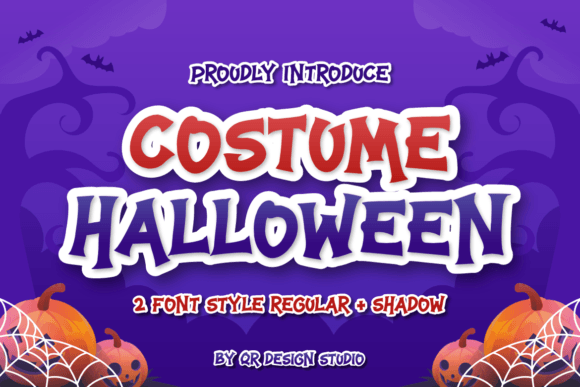
Visually, Costume Halloween walks that perfect line between playful and polished. It’s got subtle cartoon-inspired curves—think rounded terminals, friendly letterforms, and gentle unevenness that nods to hand-drawn whimsy—but without sacrificing legibility at small sizes. The uppercase letters have bold presence, while lowercase forms remain distinct and readable. It’s not overly distressed or grungy, so it works beautifully on clean kraft tags, glossy sticker sheets, or crisp white planner pages. And because it’s a true display font, it shines brightest where impact matters most: titles, headers, signage, and short bursts of text that need to stop someone mid-scroll.
I use Costume Halloween across my entire product range—especially where seasonal appeal meets everyday utility. For example, my best-selling “Boo Crew” printable party kit relies heavily on this font for cupcake toppers, banner letters, and favor tag headers. On physical products, it adds instant character to soy candle labels (paired with a soft sans serif for ingredients), boutique clothing tags (“Handmade with Witchcraft”), and even farmhouse-style wooden signs cut on my Cricut Explore Air 2. Because the letter spacing is generous and stroke contrast is moderate, it cuts cleanly at 0.25" height on vinyl—no jagged edges or lost details. For Silhouette users: yes, it outlines smoothly, and the vector-friendly curves hold up in SVG exports.
Readability matters most when scale shifts. Costume Halloween performs reliably down to 14pt in printed invitations and 10pt on product hang tags—as long as you keep it to short phrases. I avoid using it for full paragraphs or fine-print legal text, but it’s ideal for names (“Luna’s 5th Birthday”), quotes (“Trick or Treat, Seriously.”), brand slogans, and title treatments on book covers or planner covers. Its rhythm invites pause—not confusion—and that emotional pause is what turns a browser into a buyer.
Pairing Costume Halloween thoughtfully makes all the difference. My favorite combo? A relaxed script font (like a flowing handwritten style) for names or accents, layered over Costume Halloween for the main headline—say, “Welcome to the Haunted House” on a wedding welcome board. For packaging, I often pair it with a clean, neutral sans serif (think Montserrat or Inter) for body copy and barcodes. That contrast gives hierarchy, professionalism, and warmth all at once. If you’re designing a boutique gift set, try Costume Halloween for the product name and a warm serif (like Playfair Display) for the description—it creates visual storytelling without shouting.
What really sets Costume Halloween apart from other “Halloween fonts” is its versatility beyond October. I’ve used it year-round: for summer camp newsletters (swap orange for coral), back-to-school planners (“Spelling Bee Champions”), and even vintage-style bakery signs (“Fresh Baked Magic”). Its personality isn’t locked to one theme—it’s rooted in friendliness, approachability, and handmade authenticity. That’s why it fits seamlessly on children’s game boards, sticker sheets for teachers, and digital printables sold in my Etsy shop.
File-wise, Costume Halloween includes standard OpenType (.OTF) and TrueType (.TTF) formats—both work flawlessly in Canva, Adobe Illustrator, Cricut Design Space, and Silhouette Studio. There are no extra swashes or ligatures listed, which keeps things simple for crafters who prioritize consistency over ornamentation. No multilingual characters are included, so it’s best suited for English-language projects—but that’s rarely a limitation for greeting cards, labels, or seasonal decor sold in US and UK markets.
Licensing is non-negotiable when you sell physical goods or digital downloads. Costume Halloween is a commercial font, meaning you’re fully covered to use it in client work, print-on-demand items (mugs, tote bags, shirts), SVG files for cutting machines, and downloadable templates—even if you’re selling thousands of units. Just double-check your license agreement for any restrictions on embedding in apps or web fonts (not relevant for crafters). What matters most: you’re free to apply it to your candle labels, printable wall art, party kits, and boutique packaging without worrying about compliance gaps.
In practice, Costume Halloween helps me communicate quality before a customer reads a single word. When someone sees it on a hand-stamped tea towel or a foil-embossed greeting card, they subconsciously register care, intention, and creative confidence. That perception translates directly to perceived value—and higher conversion rates on listings. It’s not flashy for flashiness’ sake; it’s expressive where it needs to be, grounded where it counts.
Whether you’re designing a limited-run holiday collection, launching a new line of printable planner stickers, or labeling small-batch bath bombs, Costume Halloween delivers both aesthetic cohesion and functional reliability. It’s the kind of display font that doesn’t ask you to choose between fun and finish—it gives you both, right out of the zip file.